

Margin behaviour inside F&B-intensive assets is engineered.
Or it is left to drift.

Structural Intervention redesigns operating logic that governs F&B performance within a hotel asset.
It does not improve isolated metrics.
It restructures the conditions that shape labour cost exposure, capacity balance and financial visibility.
Erosion rarely begins in revenue.
It begins in configuration.
When operating design is misaligned, management compensates through effort.
When corrected, performance stabilises without escalation.
This is embedded system redesign.
Not advisory commentary.
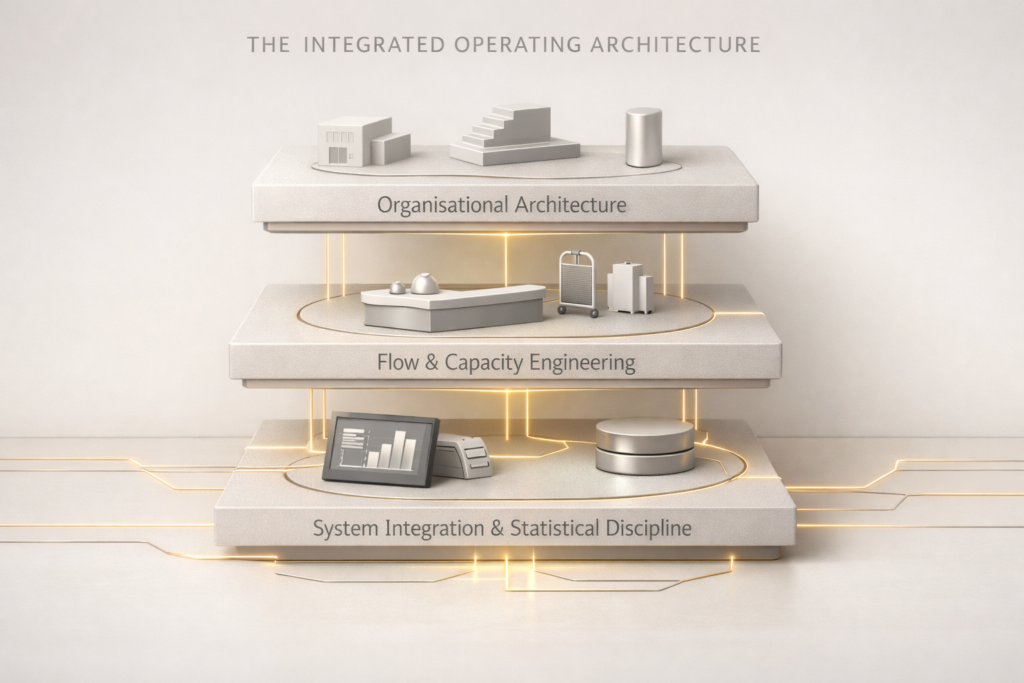
The Integrated Operating Architecture
Structural stability depends on structural alignment across three interdependent domains:
Disconnection across these domains produces cost drift and managerial overload.
Alignment restores predictability.
Operational Flow & Lean Discipline Inside F&B

Lean discipline isolates instability at source:
MUDA
unnecessary activity
Mura
uneven load
Muri
overstrain

These are configuration faults, not cultural weaknesses.
Correction normalises cost behaviour at operational source.
Control Discipline & Statistical Visibility
Instability is frequently concealed within reporting aggregates.
Operational deviation emerges in labour deployment, stock variance and service execution long before EBITDA reflects it.
Statistical control logic restores early detection.
Visibility enables correction before exposure escalates.
Control precedes stability.

Behavioural & Organisational Architecture

Misaligned configuration transfers instability to people.
Undefined scope increases decision latency.
Blurred authority escalates dependency.
Standards reliant on personality weaken governance.
Leadership fatigue is often structural, not behavioural.
Intervention redistributes authority and clarifies thresholds.
Human stability is treated as an operating variable.
Intervention Mechanics
Structural Intervention follows a defined sequence.

No advisory
decks.
No motivational campaigns.
No temporary optimisation layers.
No parallel programmes.
Stability is engineered within the asset core.
Selective Structural Engagement

This engagement is designed for F&B-intensive assets where operational variability materially influences EBITDA.
It requires executive commitment to operate against measurable thresholds and governance discipline.
This is not advisory support.
It is embedded operating correction inside the asset.
Selective by design.
Institutional by nature.