
Operational authority behind Structural Intervention

Structural Intervention is grounded in operational responsibility, not advisory theory.
Between Forks™ was founded by Verónica Sánchez Martín, an MBA-trained hospitality operator with over two decades of international experience across luxury and high-volume hotel environments.
Her career developed inside F&B-intensive assets where margin behaviour, labour structure and service pressure directly influenced overall financial performance.
This work was not built from observation.
It was built from accountability.
Operational Responsibility
Throughout her career, responsibility included full F&B P&L ownership, workforce restructuring and structural cost control within live hotel operations.
Engagement recovery, margin protection and operational stabilisation were delivered simultaneously, not sequentially.
In one high-volume environment, departmental engagement ranking moved from lowest to first position within months, while maintaining financial discipline.
In a flagship luxury asset, structural service redesign produced sustained excess demand and improved repeat guest ratios.
These results were achieved inside operating pressure, not through parallel transformation programmes
Methodological Positioning

Structural Intervention is not a collection of frameworks.
It is the integration of operational P&L discipline, Lean configuration logic, behavioural architecture and statistical control thinking applied inside F&B-intensive assets.
Most hospitality improvement efforts focus on culture, motivation or reporting.
This methodology focuses on operating architecture.
Because margin behaviour is structural before it is cultural.
Because instability is configured before it is felt.
This positioning moves the conversation from engagement initiatives to asset stability.
Operating Architecture in Practice
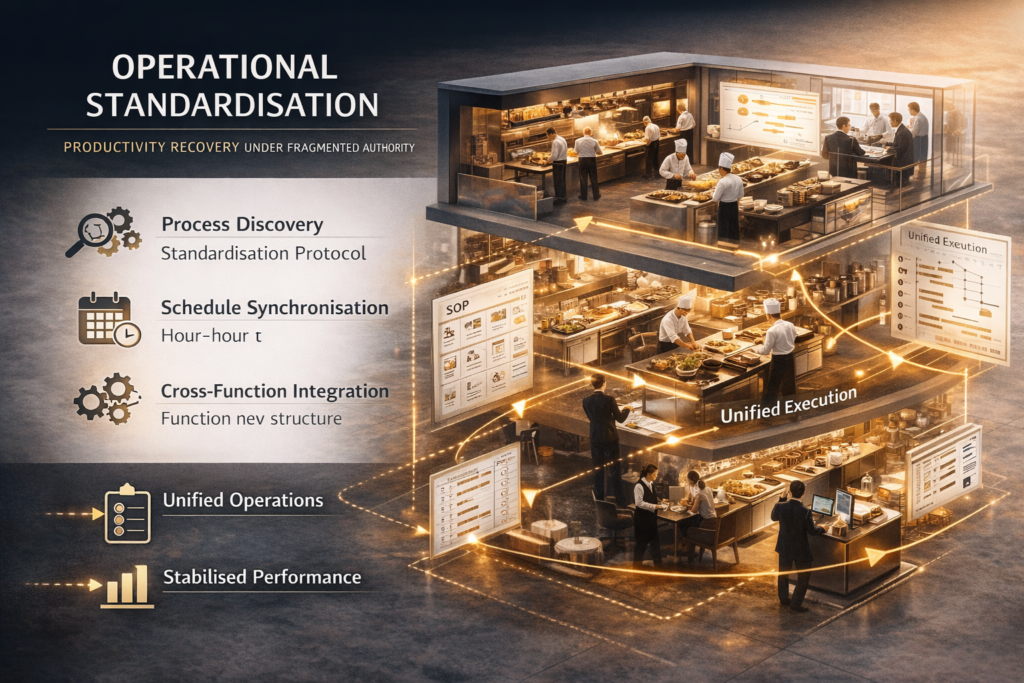
Upper-Scale Urban Asset, Northern Europe
Asset Context
Multi-outlet F&B operation with breakfast, lunch, dinner and bar functioning as semi-independent units.
High individual ownership within outlets, low cross-departmental alignment.
Service inconsistency and revenue under-leverage across outlets.
Structural Disruption
Operational standards were personality-driven rather than system-driven.
No unified SOP framework.
Shift handovers undocumented or informal.
Role boundaries unclear during peak dinner service.
Cross-selling between front office and F&B underdeveloped.
Intervention Logic
Rather than confronting high-influence individuals directly, structural clarity was introduced around them.
A unified operational handbook was developed, including visual SOP standardisation across coffee service, table setup, mise en place and service sequencing.
Shift-to-shift line-ups were formalised and embedded.
Role definitions during peak service were clarified and communicated.
Front office and concierge alignment was established to activate internal demand channels.
Operational Shift
F&B moved from personality-led execution to standardised system execution.
Service variability reduced across outlets.
Cross-departmental coordination increased.
Internal promotion of bars and restaurants improved.
Observed Stabilisation
Revenue uplift through structured cross-selling behaviour.
Improved service consistency across meal periods.
Reduced operational friction between outlets.
Noticeable stabilisation of team dynamics under pressure.
Intervention executed inside live operations without escalation or structural conflict.
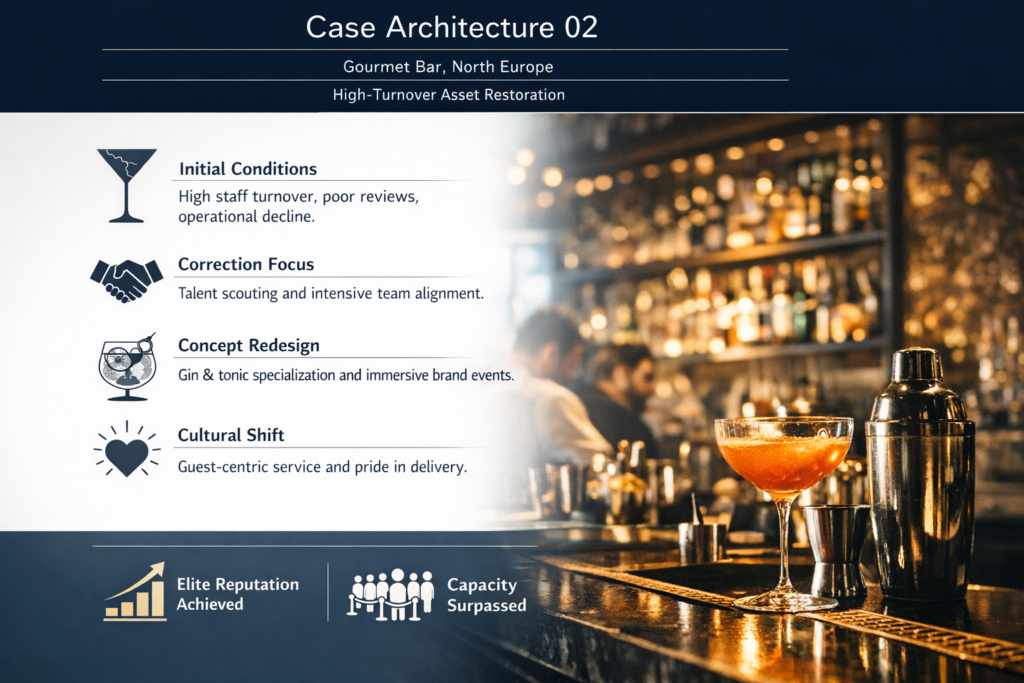
Flagship Luxury Asset Under Closure Risk, Northern Europe
Asset Context
Michelin-star affiliated bar operating within a flagship luxury hotel.
Seven consecutive leadership exits.
Talent attrition.
Negative guest perception.
Operational friction under high aesthetic design constraints.
Asset repositioning or closure under active consideration if recovery failed within the defined turnaround window.
Structural Disruption
The bar was architecturally designed for image, not for volume logic.
• Two cocktail stations insufficient for demand
• Ice supply structurally disconnected from service floor
• Glass regeneration misaligned with turnover velocity
• Storage configuration obstructing bartender flow
• Cross-department cocktail demand without capacity modelling
• Uniform design restricting mobility under high-intensity service
• Governance absence within back-office control
Leadership instability amplified design inefficiency. Operational stress translated into reputational erosion.
Intervention Logic
Recovery was not approached as morale repair. It was approached as architectural correction.
1. Spatial Reconfiguration
Service stations restructured to support four-bartender peak capacity.
Bottle allocation rationalised around rotation frequency.
Ice logistics redesigned through interim containment strategy to stabilise live service continuity.
2. Product Architecture Reset
Menu concentrated around a clear signature category, premium gin-based program.
Inventory reduced to eliminate low-rotation congestion.
Monthly signature rotation introduced to maintain novelty without stock volatility.
3. Governance & Control Discipline
Back-office systems formalised.
SOPs implemented.
Service sequencing clarified.
Credit control behaviour corrected.
Execution moved from reactive to structured.
4. Talent Architecture
Targeted external recruitment conducted personally across competitive venues to reset skill baseline.
Three key hires integrated into the restructured service model.
Uniform redesign aligned with the ergonomic reality of live cocktail production.
Creative ownership activated through:
• In-house cocktail authorship
• Interdepartmental workshops
• Competitive participation
• Experience programming
Team identity shifted from defensive to intentional.
5. Demand Activation
Marketing alignment repositioned the bar as a city destination.
Curated experiential nights.
Integrated food pairing through chef collaboration.
Internal cross-channel demand is managed through capacity thresholds.
Operational Shift
Bar transitioned from design-led concept to capacity-engineered destination.
Service continuity stabilised.
Team retention improved.
Cross-department fulfilment regained control.
Guest perception shifted from transactional to experiential.
Within the recovery window, excess demand replaced closure risk.
Security intervention became necessary during peak periods due to capacity saturation.
Regular guest loyalty deepened through personalised service culture.
Recovery achieved inside a live luxury pressure environment.
No parallel transformation programme.
No external restructuring.
Structural correction embedded within daily operation.
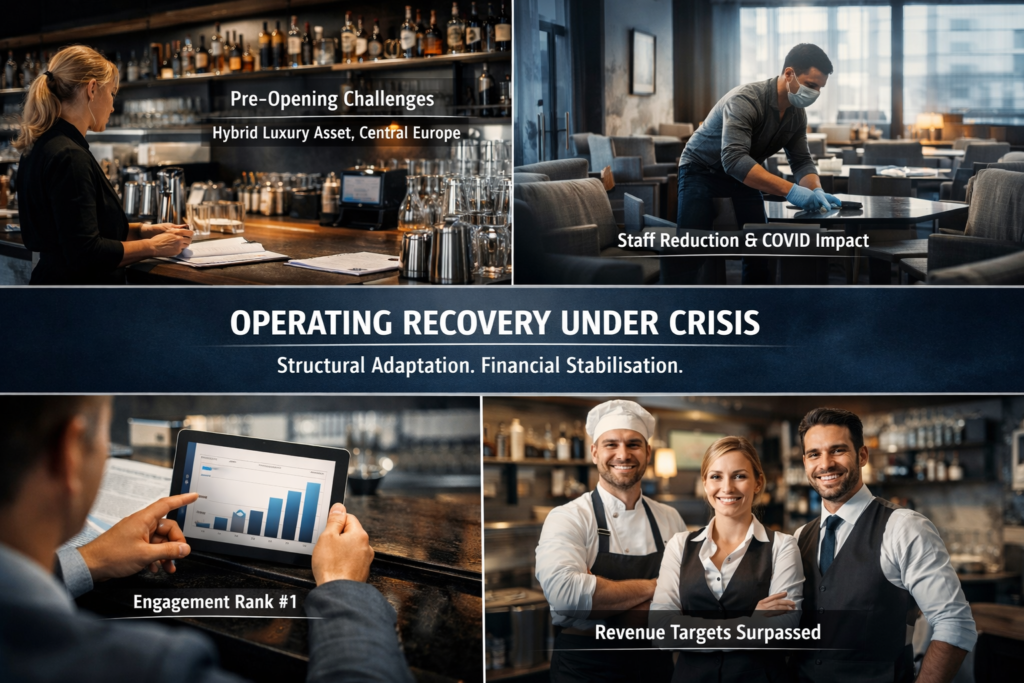
Hybrid Luxury Asset, Central Europe | Pre-Opening & Crisis Stabilisation
Asset Context
Hybrid lifestyle-luxury hotel launched under pre-opening pressure.
Architectural design prioritised guest aesthetics and visual impact over operational flow.
Structural misalignment embedded before opening:
• Low bar height restricting ergonomic production
• Columns obstructing visibility and service oversight
• Direct sun exposure disabling multiple dining tables
• Fixed seating eliminating capacity flexibility
• Terrace replication without local spatial modelling
• Insufficient service flow between kitchen and floor
Shortly after opening, COVID disruption reduced staffing while remaining the only operational hotel in the city.
F&B engagement ranking positioned lowest within portfolio.
Revenue target under active executive scrutiny.
Structural Disruption
Configuration constrained:
• Visibility
• Ergonomics
• Flow
• Capacity utilisation
Operational fatigue intensified due to spatial inefficiency.
Engagement decline threatened brand perception.
Revenue dependency increased under reduced team size.
Intervention Logic
Correction approached through structural reconfiguration rather than morale repair.
1. Spatial Adaptation Without Capital Redesign
• Removal of fixed seating to restore leg access and flexibility
• Reallocation of service stations to minimise travel distance
• Terrace micro-reconfiguration using modular furniture
• Service signals introduced to reduce unnecessary table returns
Physical space adapted to operational reality within corporate constraint.
2. Flow Engineering
• Mise en place redesigned for low-bar ergonomics
• Kitchen–floor coordination reinforced through simplified signalling
• Outlet structure simplified to reduce cross-friction
Service moved from reactive to anticipatory.
3. Labour & Schedule Reconfiguration
• Shift patterns rebuilt around team preference alignment
• Capacity deployment aligned with real demand cycles
• Reduced friction across long service distances
Energy volatility decreased.
4. Financial Transparency & Ownership Activation
• P&L shared with team
• Revenue targets communicated explicitly
• Individual development pathways aligned with operational responsibility
• Inventory and ordering accountability delegated with training
Engagement moved from emotional motivation to economic participation.
Operational Shift
Within three months:
Engagement ranking moved from lowest position to first across portfolio.
Revenue targets exceeded under COVID conditions.
Kitchen and floor coordination strengthened.
Internal promotions initiated from structured capability development.
Team communication shifted from compliance to ownership.
Observed Stabilisation
Pre-opening architectural misalignment did not determine outcome.
Structural correction stabilised:
• Cost behaviour
• Service flow
• Engagement index
• Revenue trajectory
Recovery achieved under crisis constraints without corporate redesign approval.
Architecture adapted.
Performance followed.
Executive Contact
Structural conversations begin with clarity.
For executive engagement, partnership discussions or institutional enquiries:
For operational coordination or programme logistics: